Superposition in a Toy word2vec: Three Attributes, Two Dimensions
nlp
embeddings
interpretability
deep-dive
A model can represent more features than it has dimensions. This is the geometry it uses to do it, and what it costs when the features have to share.
Author
Rosh Beed
Published
July 20, 2026
A hand-built corpus, small enough that its co-occurrence structure is exactly what I chose it to be, and a model given fewer dimensions than it has things to represent.
The idea comes from Anthropic’s Toy Models of Superposition. A model can represent more features than it has dimensions by packing feature directions into the same space, instead of giving each one its own axis. Seeing it happen means controlling the structure, rather than taking whatever 17 million words of text8 happen to contain.
The Setup
Three attributes, two values each:
Attribute
Values
Status
noble / common
Gender
masc / fem
Age
adult / young
Combined, they give eight words:
king     = noble  + masc + adult      queen    = noble  + fem + adult
man      = common + masc + adult      woman    = common + fem + adult
prince   = noble  + masc + young      princess = noble  + fem + young
boy      = common + masc + young      girl     = common + fem + young
Each of the six attribute values gets its own word, which I will call a pole. Each of the eight words above co-occurs with its three poles.
The corpus is built from a cycle. The six poles sit in a ring, arranged so that opposites are three steps apart:
noble — masc — adult — common — fem — young — noble
That ring is what spreads the poles out evenly. Each pole also gets a self-loop, and each corner word touches only its own three poles, once each. Sixty-six co-occurrence pairs in total.
Show the code
# Setup, inlined rather than imported so this notebook runs on its own.# Keep it folded; nothing below it depends on anything outside this file.import matplotlib.pyplot as plt# --- chart styling -------------------------------------------------------# Categorical slots of a CVD-validated palette: blue, orange, aqua, purple.COLOURS = ["#2a78d6", "#eb6834", "#1baf7a", "#8a63d2"]MUTED, GRID, AXIS ="#5b6570", "#e6e6e3", "#d5d5d1"def style_axes(ax, xlabel=None, ylabel=None, grid="y"):"""Strip an axes back to the ink that carries information."""if xlabel: ax.set_xlabel(xlabel, color=MUTED, fontsize=9)if ylabel: ax.set_ylabel(ylabel, color=MUTED, fontsize=9)if grid: ax.grid(axis=grid, color=GRID, linewidth=0.8) ax.set_axisbelow(True)for side in ("top", "right"): ax.spines[side].set_visible(False)for side in ("left", "bottom"): ax.spines[side].set_color(AXIS) ax.tick_params(colors=MUTED, labelsize=9, length=0)return axdef figure(width=7.0, height=4.2, **kw): fig, ax = plt.subplots(figsize=(width, height), **kw)return fig, aximport numpy as npfrom itertools import combinationsPOLES = ["noble", "common", "masc", "fem", "adult", "young"]SYNONYMS = {"noble": ["royal", "crown", "regal"], "common": ["peasant", "serf", "lowly"],"masc": ["he", "him", "his"], "fem": ["she", "her", "hers"],"adult": ["grown", "elder", "mature"], "young": ["child", "youth", "junior"],}CYCLE = ["noble", "masc", "adult", "common", "fem", "young"] # opposites 3 apartCORNERS = {"king": ("noble", "masc", "adult"), "queen": ("noble", "fem", "adult"),"man": ("common", "masc", "adult"), "woman": ("common", "fem", "adult"),"prince": ("noble", "masc", "young"), "princess": ("noble", "fem", "young"),"boy": ("common", "masc", "young"), "girl": ("common", "fem", "young"),}def sparse_corpus():"""The pole cycle, self-loops, and each corner touching only its own poles.""" corpus = [f"{CYCLE[i]}{CYCLE[(i +1) %6]}"for i inrange(6)] *2 corpus += [f"{p}{p}"for p in POLES]for corner, poles in CORNERS.items():for p in poles: corpus += [f"{corner}{p}", f"{p}{corner}"]return corpusprint(f"{len(sparse_corpus())} co-occurrence pairs, "f"{len({w for s in sparse_corpus() for w in s.split()})} words")
66 co-occurrence pairs, 14 words
The model is skip-gram with negative sampling, the training method word2vec actually uses, written out in plain numpy. Every word gets a vector. For each word, pull it toward the words it appears next to and push it away from a random word it doesn’t.
Be clear about what is designed here and what is not. The ring is designed: I put opposites three steps apart, and a six-cycle laid out in a plane is a hexagon, so the model is handed a strong hint about where the poles should go.
What is not designed is the geometry. Nothing in the corpus mentions a dimension, an angle or a direction. The model only ever sees which words sit next to which. That opposites come out antipodal, that the three axes settle 60° apart, and that two specific words cancel to nothing are all consequences of the counting.
Show the code
def train(corpus, dim, seed=9, window=2, lr0=0.01, epochs=2000): vocab =sorted({w for s in corpus for w in s.split()}) index = {w: i for i, w inenumerate(vocab)} pairs = [(c, x) for s in corpusfor ids in [[index[w] for w in s.split()]]for i, c inenumerate(ids) for j, x inenumerate(ids)if0<abs(i - j) <= window] counts = np.array([sum(s.split().count(w) for s in corpus) for w in vocab], float) unigram = counts **0.75 unigram /= unigram.sum() sigmoid =lambda x: 1/ (1+ np.exp(-np.clip(x, -50, 50))) rng = np.random.RandomState(seed) W_in = rng.uniform(-0.5/ dim, 0.5/ dim, (len(vocab), dim)) W_out = rng.uniform(-0.5/ dim, 0.5/ dim, (len(vocab), dim))for epoch inrange(epochs): lr = lr0 * (1- epoch / epochs)for centre, context in pairs: negatives = rng.choice(len(vocab), size=1, p=unigram) negatives = negatives[negatives != context] targets = np.concatenate(([context], negatives)) labels = np.r_[1, [0] * (len(targets) -1)] error = sigmoid(W_in[centre] @ W_out[targets].T) - labels W_out[targets] -= lr * np.outer(error, W_in[centre]) W_in[centre] -= lr * (error @ W_out[targets])return {w: v for w, v inzip(vocab, W_in - W_in.mean(0))}
Three Dimensions
Three attributes suggests three dimensions, one per attribute. Train it that way first and that is what you get: the three attribute directions come out near perpendicular, nothing has to share, and every analogy lands on the right word.
Show the code
def pole(vectors, name):"""The dense corpus has no token named after its pole, so average its synonyms."""if name in vectors:return vectors[name]return np.mean([vectors[t] for t in SYNONYMS[name]], axis=0)def axis(vectors, a, b):"""The direction an attribute points, from one pole to its opposite.""" d = pole(vectors, a) - pole(vectors, b)return d / np.linalg.norm(d)AXES = {"status": ("noble", "common"), "gender": ("masc", "fem"), "age": ("adult", "young")}vectors_3d = train(sparse_corpus(), dim=3)directions = {name: axis(vectors_3d, a, b) for name, (a, b) in AXES.items()}names =list(AXES)for i, a inenumerate(names):for b in names[i +1:]: angle = np.degrees(np.arccos(np.clip(directions[a] @ directions[b], -1, 1)))print(f"{a:>7} to {b:<7}{angle:6.1f} degrees apart")
 status to gender    80.1 degrees apart
 status to age       99.1 degrees apart
 gender to age       80.3 degrees apart
Near enough to right angles. Each attribute has an axis to itself.
Two Dimensions
Now take one away. Same eight words, same three attributes, one fewer dimension to put them in.
Show the code
vectors = train(sparse_corpus(), dim=2)print("pole angles, measured from the x axis\n")for p insorted(POLES, key=lambda p: np.degrees(np.arctan2(*vectors[p][::-1])) %360):print(f" {p:<8}{np.degrees(np.arctan2(*vectors[p][::-1])) %360:7.1f}")print()for name, (a, b) in AXES.items(): v, w = vectors[a], vectors[b] opposite = np.degrees(np.arccos(np.clip(v @ w / (np.linalg.norm(v) * np.linalg.norm(w)), -1, 1)))print(f" {a:>6} to {b:<8}{opposite:6.1f} degrees")
pole angles, measured from the x axis

  noble       11.4
  masc        71.2
  adult      133.1
  common     192.5
  fem        251.4
  young      312.7

   noble to common    178.9 degrees
    masc to fem       179.8 degrees
   adult to young     179.6 degrees
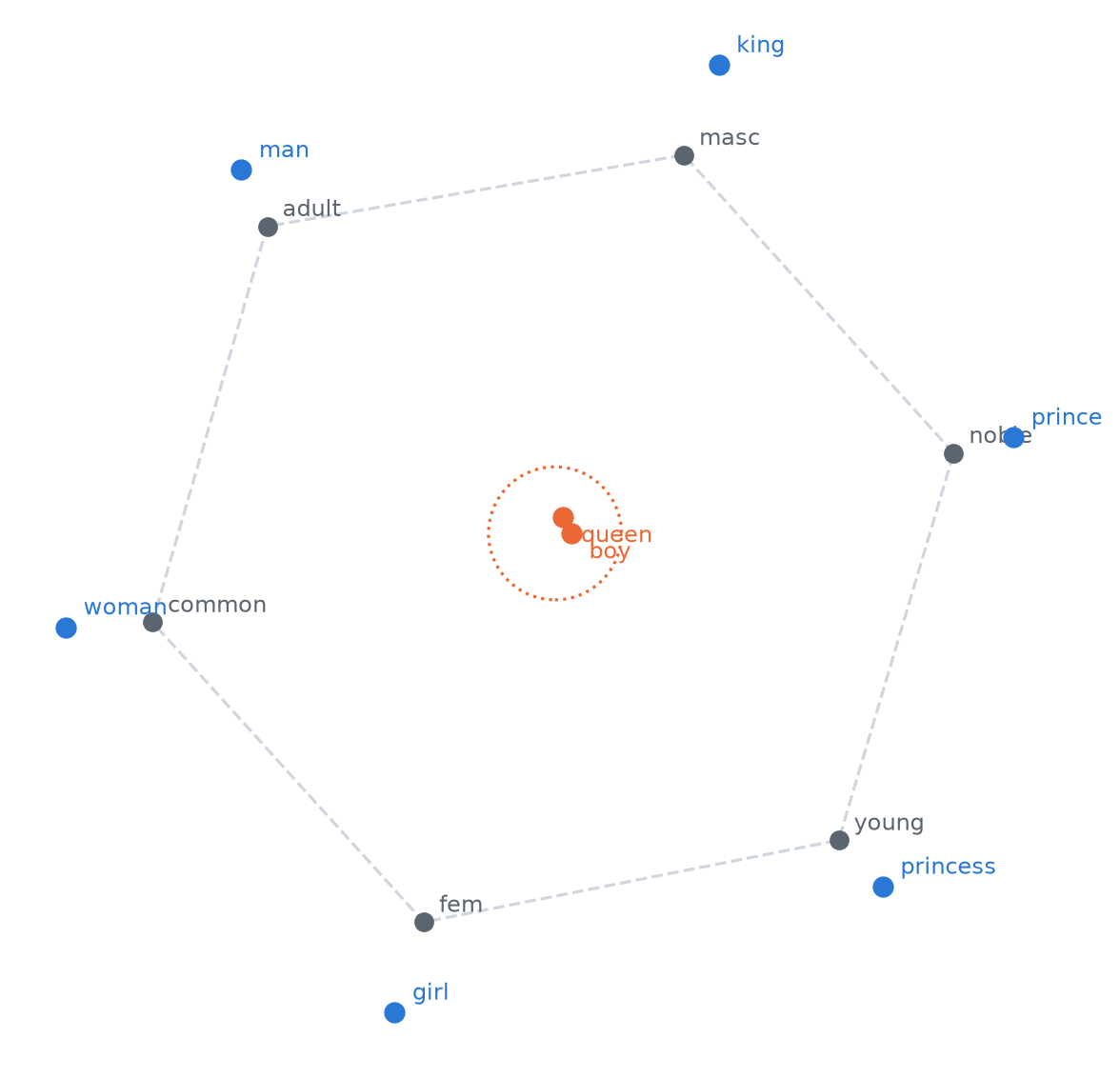
The six poles have spread into a hexagon. Each attribute is still an opposite pair, near enough antipodal. But the three axes now sit 60 degrees apart rather than 90.
They cannot be perpendicular any more, so they share the plane. Three attributes represented in a space with room for two, paid for by giving up the right angles. That’s superposition.
Show the code
import matplotlib.pyplot as pltfig, ax = figure(width=6.6, height=6.0)ring = np.array([vectors[p] for p in CYCLE + [CYCLE[0]]])ax.plot(ring[:, 0], ring[:, 1], color="#cfd6de", linewidth=1.2, linestyle="--", zorder=1)for p in POLES: x, y = vectors[p] ax.scatter(x, y, s=46, color=MUTED, zorder=3) ax.annotate(p, (x, y), xytext=(6, 4), textcoords="offset points", fontsize=9, color=MUTED)for corner in CORNERS: x, y = vectors[corner] faded = np.linalg.norm(vectors[corner]) <0.5 ax.scatter(x, y, s=54, color=COLOURS[1] if faded else COLOURS[0], zorder=4) ax.annotate(corner, (x, y), xytext=(7, -10if faded else5), textcoords="offset points", fontsize=9, color=COLOURS[1] if faded else COLOURS[0])ax.add_patch(plt.Circle((0, 0), 0.22, fill=False, linestyle=":", color=COLOURS[1], linewidth=1.2))ax.set_aspect("equal")style_axes(ax, grid=None)ax.set_xticks([]); ax.set_yticks([])for s in ax.spines.values(): s.set_visible(False)fig.tight_layout()
Figure 1: Three attributes in two dimensions. The six poles spread into a hexagon, and two of the eight corner words have been cancelled to the origin.
Two Words Disappear
Look at the middle of that plot. queen and boy are sitting on the origin, on top of each other, despite sharing no attributes at all.
They have not drifted there. They have been cancelled.
Show the code
for corner insorted(CORNERS, key=lambda c: np.linalg.norm(vectors[c])):print(f" {corner:<9}{np.linalg.norm(vectors[corner]):.3f}")
  boy       0.054
  queen     0.061
  prince    1.549
  man       1.589
  princess  1.594
  king      1.642
  woman     1.648
  girl      1.671
Six words sit out at about 1.6. Two are at 0.05.
A corner word is only ever pulled toward its own three poles, so where it ends up is decided by where those three point. Add them up and compare:
Show the code
print(f"{'corner':<10}{'|sum of its poles|':>20}{'|the corner|':>15}{'aligned':>10}")for corner, poles in CORNERS.items(): total =sum(vectors[p] for p in poles) length, corner_length = np.linalg.norm(total), np.linalg.norm(vectors[corner])print(f"{corner:<10}{length:>20.3f}{corner_length:>15.3f}"f"{total @ vectors[corner] / (length * corner_length):>+10.2f}")
corner      |sum of its poles|   |the corner|   aligned
king                     2.654          1.642     +1.00
queen                    0.067          0.061     -0.50
man                      2.710          1.589     +1.00
woman                    2.776          1.648     +1.00
prince                   2.730          1.549     +1.00
princess                 2.733          1.594     +1.00
boy                      0.067          0.054     +0.48
girl                     2.724          1.671     +1.00
For six of the eight, the three poles add to something long and the corner sits along it at roughly 60% of the length. For queen and boy that same sum is a fortieth of the size. Nothing cancelled those two corners; their poles cancelled each other before the corner got there.
Ignore the last column on those two rows. It is the angle between two vectors that are both essentially zero, so it can come out at anything.
The hexagon says why. queen is noble + fem + adult, which sit at 11°, 251° and 133° — each pair 120° apart. Three vectors of roughly equal length at 120° sum to nothing. boy is common + masc + young, the same tripod rotated.
Those are the only two corners this happens to, and it is not luck. Go around the pole cycle taking every other pole and you get exactly two triples, {noble, adult, fem} and {common, masc, young}. Every other corner takes three poles spanning a 120° arc, which add up constructively instead.
So you can predict which two words will vanish by looking at the cycle, before you train anything. I didn’t expect that. I assumed interference would show up as general noise. Instead it picked two specific words and deleted them.
The Analogies Still Pass
Take the predicted point, look up its nearest word, and every analogy comes back correct.
Show the code
TESTS = [("king", "man", "woman", "queen"), ("king", "prince", "princess", "queen"), ("man", "king", "prince", "boy"), ("king", "queen", "woman", "man"), ("prince", "boy", "girl", "princess")]print(f"{'analogy':<32}{'nearest':>10}{'error':>8}{'margin':>9}")for a, b, c, expected in TESTS: target = vectors[a] - vectors[b] + vectors[c] ranked =sorted(((np.linalg.norm(vectors[w] - target), w) for w in CORNERS)) (err, nearest), (runner_up, _) = ranked[0], ranked[1] flag =""if nearest == expected else" <- wrong"print(f"{a +' - '+ b +' + '+ c:<32}{nearest:>10}{err:>8.3f}{runner_up - err:>9.3f}{flag}")
analogy                            nearest   error   margin
king - man + woman                   queen   0.069    0.031
king - prince + princess             queen   0.082    0.001
man - king + prince                    boy   0.120    0.003
king - queen + woman                   man   0.069    1.511
prince - boy + girl               princess   0.182    1.315
Every one is right. Look at the margins.
The bottom two beat their runner-up by well over a point. They are in no danger. The middle two win by a thousandth. A model doesn’t get an answer right by that margin. A coin lands on its edge by that margin.
Both of the close ones are aiming at queen or boy, the two words sitting on the origin a fraction apart. Anything pointing at one of them is choosing between two words that are, for practical purposes, in the same place.
And the coin does land the other way. Re-running the same corpus at eleven other seeds gives twelve different collapses, and the close analogies come back as the wrong word in ten of the twelve.
Show the code
SEEDS = (9, 21, 13, 6, 2, 23, 16, 1, 10, 18, 20, 15)def misreads(vs):"""How many of the five analogies come back as the wrong word.""" wrong =0for a, b, c, expected in TESTS: target = vs[a] - vs[b] + vs[c] wrong +=min((np.linalg.norm(vs[w] - target), w) for w in CORNERS)[1] != expectedreturn wrongruns =sorted((min(np.linalg.norm(v[c]) for c in CORNERS), misreads(v), seed)for seed in SEEDSfor v in [train(sparse_corpus(), dim=2, seed=seed)])print(f"{'smallest corner':>16}{'seed':>7}{'of 5 misread':>15}")for smallest, wrong, seed in runs:print(f"{smallest:>16.3f}{seed:>7}{wrong:>15}")half =len(runs) //2worst = np.mean([r[1] for r in runs[:half]])mildest = np.mean([r[1] for r in runs[half:]])print(f"\nthe {half} hardest collapses misread {worst:.1f} of 5 on average")print(f"the {half} mildest collapses misread {mildest:.1f} of 5 on average")
 smallest corner   seed   of 5 misread
           0.054      9              0
           0.200     21              2
           0.284     13              0
           0.413      6              2
           0.441      2              2
           0.442     23              1
           0.451     16              2
           0.507      1              2
           0.539     10              1
           0.543     18              3
           0.545     20              1
           0.554     15              3

the 6 hardest collapses misread 1.2 of 5 on average
the 6 mildest collapses misread 2.0 of 5 on average
Read the two columns against each other. If superposition damaged the embedding in the way you would expect, the runs with the hardest collapse would be the ones that fail the analogies. They are not: the relationship runs the other way, weakly, and the single worst collapse of the twelve gets all five right.
So this is not “worse embedding, worse score”. Whether the analogies pass tells you very little about whether the space behind them is any good.
The three-dimensional model makes the same point from the other side. There the errors are larger, and every answer is nearest its target by a mile. The 2D model is better at hitting the target and worse at being understood, because in 2D the target has someone else standing on it.
The Corpus Decides
None of this works on a corpus you would get by accident.
A denser corpus does not. Give each pole three interchangeable synonym tokens, let every corner word co-occur with all of them, and add pairs between the synonyms to hold each pole together: ninety co-occurrence pairs against the sixty-six above.
That works some of the time and not others. On four seeds out of ten, two or three of the attribute directions end up on the same line.
Show the code
def dense_corpus():"""Every corner co-occurs with all three tokens of each of its poles, plus struts.""" corpus = [f"{corner}{tok}"for corner, poles in CORNERS.items()for p in poles for tok in SYNONYMS[p]] corpus += [f"{a}{b}"for toks in SYNONYMS.values() for a, b in combinations(toks, 2)]return corpusdense = train(dense_corpus(), dim=2)dense_dirs = {name: axis(dense, a, b) for name, (a, b) in AXES.items()}print(f"{'':>18}{'sparse':>9}{'dense':>9}")names =list(AXES)for i, a inenumerate(names):for b in names[i +1:]: sp = np.degrees(np.arccos(np.clip(axis(vectors, *AXES[a]) @ axis(vectors, *AXES[b]), -1, 1))) dn = np.degrees(np.arccos(np.clip(dense_dirs[a] @ dense_dirs[b], -1, 1)))print(f"{a +' to '+ b:>18}{sp:>8.0f}°{dn:>8.0f}°")
                     sparse    dense
  status to gender      59°     179°
     status to age     121°       2°
     gender to age      62°     176°
Same model, same attributes, same seed. Only the corpus changes. In the dense column the three attribute directions have collapsed onto one line: 179° and 2° are both “the same axis”, just pointing opposite ways.
What fixed it was giving the model less to work with, not more. The extra edges were the problem. Every corner pulling on every synonym of every pole gives the poles a reason to bunch together, and once two of them bunch there’s nothing holding the third direction apart.
I assumed this was a space problem that a third dimension would fix. It’s not. At three dimensions, with a whole dimension per attribute going spare, the dense corpus still sits about 27° off orthogonal on average against the sparse corpus’s 12°, usually by fusing two attributes onto one axis.
Conclusion
A model can represent more features than it has dimensions, by giving up the right angles between them
The cost is interference, and here it is not spread evenly as noise
It picked two specific words and cancelled them to zero, predictably, from the structure of the corpus alone
The analogy tests still pass, two of them by 0.001
Passing the test tells you almost nothing about whether the space is any good
That last point is the one I would take anywhere else. The arithmetic still moves in the right direction, the errors stay small, and the analogies still come back correct. Superposition does not announce itself.